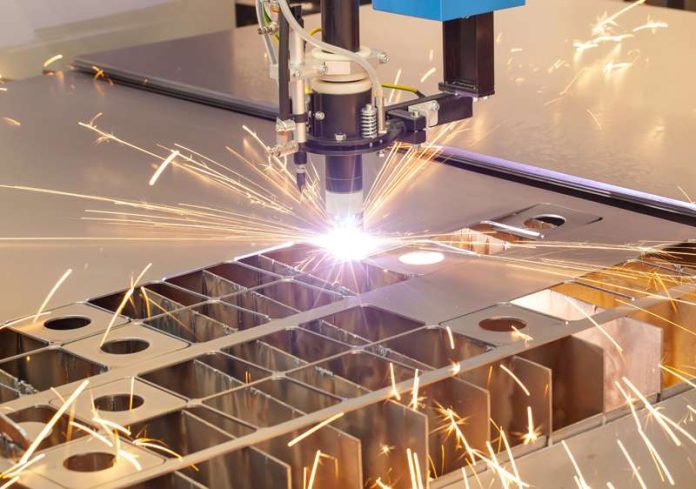

Precision begins long before the first spark touches metal. Every fabrication process has its strengths, but the way a plasma cutter removes material makes it fundamentally different from mechanical blades, lasers, and fuel-driven torches. Understanding those differences helps manufacturers select equipment that fits production goals instead of simply following familiar methods.
Why Ionized Arc Technology Cuts Conductive Metals Without Mechanical Contact
Unlike saw blades or milling tools that rely on physical contact, a plasma cutter forms an extremely hot electrical arc that passes through compressed gas. This gas becomes plasma, producing temperatures capable of melting conductive metals almost instantly while forcing molten material away from the cut. Since no cutting edge physically presses against the workpiece, there is less tool wear than many traditional cutting systems experience.
Mechanical cutting methods gradually dull blades and require frequent sharpening or replacement as materials become harder or thicker. Plasma technology avoids that limitation because the torch performs the work through concentrated thermal energy rather than friction. This operating principle allows manufacturers to maintain consistent production while reducing interruptions caused by worn cutting tools.
How Plasma Processing Delivers Faster Material Removal Across Production Runs
Production speed often separates one fabrication method from another. Compared with many mechanical cutting processes, a CNC plasma cutter moves rapidly across steel, stainless steel, and aluminum while maintaining reliable cutting performance on a wide variety of part geometries.
Higher travel speeds become especially valuable during large production runs where hundreds of identical components must be completed within tight schedules. Faster processing also helps reduce bottlenecks between fabrication stages, allowing downstream operations such as bending, welding, and assembly to begin sooner without waiting on finished parts.
Material Thickness Determines Where Plasma Holds a Competitive Advantage
Every cutting process performs differently depending on material thickness. Plasma offers excellent performance across a broad range of conductive metals, making it a practical solution for structural fabrication, equipment manufacturing, heavy machinery components, and industrial production.
Certain thin materials may benefit from laser technology when extremely fine tolerances are required, while very thick specialty applications may call for different equipment altogether. A CNC plasma cutting machine fills an important middle ground by combining strong productivity with dependable edge quality on many commonly processed metal thicknesses.
Computer Controlled Motion Creates Repeatable Parts With Greater Consistency
Modern fabrication depends on repeatability as much as speed. Once programmed, a CNC plasma cutter follows digital toolpaths with remarkable consistency, allowing hundreds of identical components to be produced without relying solely on manual operator skill.
Complex contours, bolt holes, slots, brackets, and intricate profiles become easier to reproduce because every programmed movement follows the same coordinates. Manufacturers searching for CNC companies near me frequently prioritize automated plasma systems because consistency directly influences assembly accuracy and product quality.
Heat Distribution Produces Different Edge Characteristics Than Mechanical Tools
Every cutting process leaves its own signature behind. Mechanical cutting may create burrs from blade pressure, while plasma leaves edges shaped by concentrated thermal energy and controlled gas flow.
Proper machine settings help minimize slag while producing smooth edges that require relatively little finishing on many applications. Feed rate, amperage, torch height, and gas selection all influence final cut quality, making machine setup just as important as the cutting equipment itself.
Flexible Geometry Makes Intricate Shapes Easier Than Traditional Methods
Straight cuts rarely represent the entire workload inside modern fabrication facilities. Equipment manufacturers regularly require curved profiles, nested components, internal openings, and irregular part geometries that would be difficult or time-consuming using manual tools.
Computer-controlled plasma systems transition smoothly between straight lines and detailed contours without changing equipment. That flexibility allows fabricators to maximize material usage while producing components that meet complex engineering drawings with greater efficiency.
Lower Setup Complexity Helps Manufacturers Respond to Design Changes Faster
Production requirements rarely remain fixed for long. Customer revisions, engineering improvements, and product updates often require fabrication shops to modify cutting programs with very little notice.
Digital programming makes those adjustments considerably easier than rebuilding dedicated tooling or replacing mechanical fixtures. Updated designs can often move directly from CAD files into production, allowing a CNC machine company to respond more quickly without sacrificing consistency or production quality.
Production Efficiency Depends on Matching the Right Process to the Right Job
No single cutting method solves every manufacturing challenge. Successful production depends on selecting equipment that aligns with material type, thickness, production volume, required tolerances, downstream operations, and overall manufacturing objectives.
Plasma continues to earn its place because it balances cutting speed, operational flexibility, and dependable performance across many industrial applications. Amtec Solutions Group helps manufacturers evaluate production requirements and implement plasma cutting technologies that improve fabrication efficiency while supporting precision manufacturing across a wide range of industrial projects